

Ground control to SpacerGal your circuit's dead, is something wrong? Can you hear me SpacerGal? Can you here me SpacerGal?! Here, I've been floating 'round my tin can, far above the world. But, I'm back, rock references in full force, bringing you a roleplaying update, a big boy game review, AND a Child at Heart review! I figure I've been gone for far too long, so why not come back with a bang? So without further ado, let's get things started!
Saurian Insanity
So, as the Snowman mentioned, the addition of the Saurian druid variant in Pathfinder's Ultimate Magic book really made me want to step out from behind the screen and be a PC again. The concept was a little bit more Land of the Lost than Conan, with me never speaking English while in character. Instead, whenever using first-person dialogue, I plan to use the (ready for this under-rated reference point?) Star Fox Adventures saurian language spoken by all the dinosaur planet inhabitants during cut-scenes. Pretty crazy, right? But hey, that's how I do, getting wacky for experimentation's sake. As far as settings go, the Snowman and I have been collaborating on both a high- and low-fantasy versions of dinosaur inhabited worlds for characters to explore. Full write-up on that to come once we finish fleshing it out in it's entirity.
Returning to Raccoon City...
I was down at one of the local game shops lately and stumbled across the Resident Evil Deckbuilding Game. I still had some fun money, and the box has my main RE squeeze on it, so we picked it up and gave it a whirl. Turns out, Bandai and Capcom have turned out a pretty great, fast-paced, (kinda) balanced DBG that I think can definitely stand up with the other big boys coming out this year from Fantasy Flight.

Look at Leon Kennedy all silly with his bangs all around. Yay!

Look at Leon Kennedy all silly with his bangs all around. Yay!
Normally, with a game in a genre getting as crowded as the deckbuilding genre, I'd make a comparison to another game, but I've never actually played Dominion, or Thunderstone, or any of the other hyped up titles. Being my first encounter with a DBG, I didn't fully know what to expect other than a slightly "different experience with each game." So let's dig in and see what makes this game stand out in my collection.
First off, this game is easy to learn, and easy to play. Obviously there are certain strategies to it, what to buy for your deck and when, but overall, anyone can play this game, and I think that's nice. I have a ton of friends who aren't tabletop gamers, but would give this a try simply because of the franchise, and they wouldn't be lost or confused. Every turn, you get an Action, Buy, and Explore to use, and can earn more depending on what cards you play. Actions are used to gain extra damage, draw extra cards, score more Buys, and other cool effects. Buys are pretty obviously when you spend money to add a card to your discard pile, which shuffles and resets as your deck every time you run out of cards. Exploring lets you hunt zombies to kill and score points, but don't get too hasty to score, because if you can't kill the random zombie that flips from the top of the Mansion deck, you'll end up with damage, and that can mean loss of turns, or even the whole game.
We most often play Mercenary mode, one of the three different game modes provided in the rules. It's the fastest played and the least based on stalling and grinding up a ridiculous deck, plus all the characters are more unique, in that they get specific staring decks instead of the stock one used in Versus and Story modes. In Mercenary, you have 15 rounds to score as many points worth of dead zombies as possible, giving it a rapid-fire arcade type feel. It also removes the three super-huge zombies from the Mansion deck, so you don't have to be worried about being one-shot. In Story, the first player to kill the one copy of the biggest infected monstrosity wins. With him coming up at random, and being ludicrously powerful, it can be a frustrating game when you get blasted for 70 damage out of your 80 health on turn 2, but the duration means you can spend more time fine-tuning and customizing your deck. Versus is just what it sound like. Instead of using your Explore action to fight zombies, you shoot at other players, aiming to be the last one standing. With how powerful some of the character abilities are, it seems this mode can get unbalanced really fast, but it is a fun little diversion if you feel like really mixing things up a bit. No matter what game mode you are playing, you use a Scenario to determine what cards will be used. There are certain basic resources that are always there, which are the Knife, Pistol, Green Herb, and three levels of ammunition/gold. The Scenarios add 12 more cards to the available purchasable pools, called resources, and they are usually themed. For example, the Special Forces uses a lot of higher-powered specialty weapons and bonus ammo and damage actions, whereas Mobility uses less super guns and more actions that draw cards and add to your deck. This added variety on top of three included game modes makes Resident Evil remarkably replayable, and a blast for anyone into zombies, the RE franchise, card games, or fun.
First off, this game is easy to learn, and easy to play. Obviously there are certain strategies to it, what to buy for your deck and when, but overall, anyone can play this game, and I think that's nice. I have a ton of friends who aren't tabletop gamers, but would give this a try simply because of the franchise, and they wouldn't be lost or confused. Every turn, you get an Action, Buy, and Explore to use, and can earn more depending on what cards you play. Actions are used to gain extra damage, draw extra cards, score more Buys, and other cool effects. Buys are pretty obviously when you spend money to add a card to your discard pile, which shuffles and resets as your deck every time you run out of cards. Exploring lets you hunt zombies to kill and score points, but don't get too hasty to score, because if you can't kill the random zombie that flips from the top of the Mansion deck, you'll end up with damage, and that can mean loss of turns, or even the whole game.
We most often play Mercenary mode, one of the three different game modes provided in the rules. It's the fastest played and the least based on stalling and grinding up a ridiculous deck, plus all the characters are more unique, in that they get specific staring decks instead of the stock one used in Versus and Story modes. In Mercenary, you have 15 rounds to score as many points worth of dead zombies as possible, giving it a rapid-fire arcade type feel. It also removes the three super-huge zombies from the Mansion deck, so you don't have to be worried about being one-shot. In Story, the first player to kill the one copy of the biggest infected monstrosity wins. With him coming up at random, and being ludicrously powerful, it can be a frustrating game when you get blasted for 70 damage out of your 80 health on turn 2, but the duration means you can spend more time fine-tuning and customizing your deck. Versus is just what it sound like. Instead of using your Explore action to fight zombies, you shoot at other players, aiming to be the last one standing. With how powerful some of the character abilities are, it seems this mode can get unbalanced really fast, but it is a fun little diversion if you feel like really mixing things up a bit. No matter what game mode you are playing, you use a Scenario to determine what cards will be used. There are certain basic resources that are always there, which are the Knife, Pistol, Green Herb, and three levels of ammunition/gold. The Scenarios add 12 more cards to the available purchasable pools, called resources, and they are usually themed. For example, the Special Forces uses a lot of higher-powered specialty weapons and bonus ammo and damage actions, whereas Mobility uses less super guns and more actions that draw cards and add to your deck. This added variety on top of three included game modes makes Resident Evil remarkably replayable, and a blast for anyone into zombies, the RE franchise, card games, or fun.
I Wanna Be the Very Best
Pokemon. I love it. Look at me however you want with those judging eyes, but this 24-year-old is all about Pokemon in whatever form she can get it. Video games, plushes, figures, and of course, the card game, which is what we're here to talk about. Having not played the card game since my middle-school years, I figured I'd pick up some new theme decks and give it a whirl. Needless to say, I still find it as fun as I used to, but I do have some criticism for it.

Two new theme decks from a brand new set, featuring Krookodile and Scolipede. I'm positive you can figure out which is which.
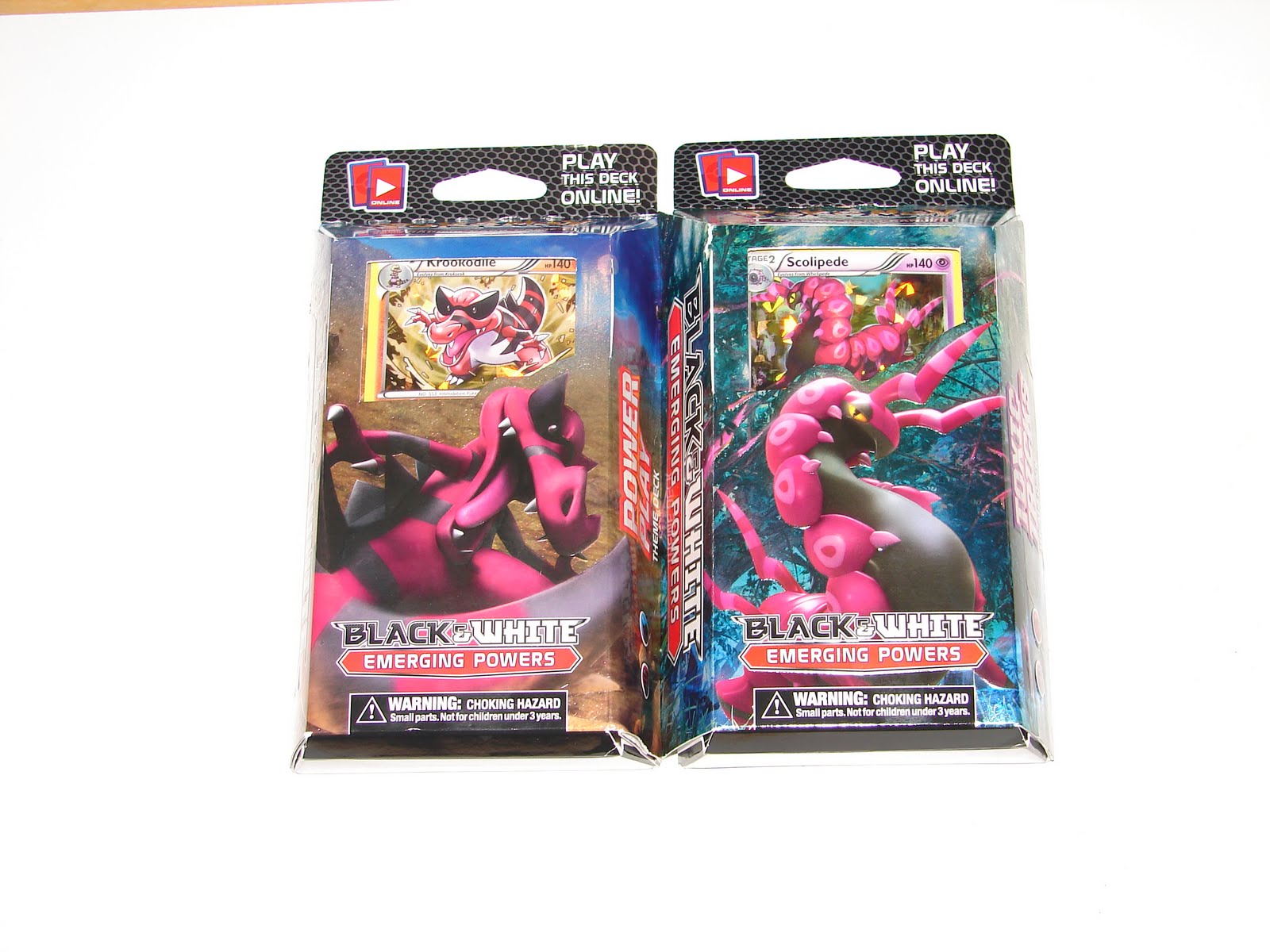
Two new theme decks from a brand new set, featuring Krookodile and Scolipede. I'm positive you can figure out which is which.
One of the first major things I noticed when in the store was the sheer size of the deck box. I thought, this thing is huge for just housing a 60-card starter deck. But when I got home and cracked it open, I discovered that it didn't just have a deck of cards in a huge plastic insert. Take a look at this craziness!
 That's a deck, a sheet of surprising decent quality damage and status counters, a set checklist in poster format, that giant two-player starter mat everything is sitting on top of which has the rules printed on the back, a 16-character code card that unlocks the deck for online play on the Pokemon TCG website (more on that later), a shiny little coin for all the coin-flip effects in this game and my favorite part, the thing I think should come with EVERY boxed card game product...
 ...Oh em gee, a deck box. Cardboard yes, but still, a nifty deck box themed to the deck to hold your new cards in when not using them. I could kiss whoever thought to include these in the marketing department. Now that I've gone over what you get in the box, let's actually look at playing some Pokemon TCG.
The rules to the game are simple. At the start of the game you put out a basic pokemon as your "active" pokemon and may place as many additional basic pokemon as you like in your "bench" area as "bench pokemon." If your active is defeated, one of these is chosen to step up and replace it. After you've got your pokemon out, you take the top six cards of the deck and set them aside as "prize cards." For each pokemon of your opponent's you defeat, you pick up a prize card. Pick up all six and you win! Each pokemon has at least one attack printed on it to start walloping your opponent. These attacks require energy cards to use, and you can only attach one energy per turn, much like lands in magic. Think your active pokemon is going to get dropped in one more attack? Maybe you should attach the energy to something on your bench so it can come in powered up, or do you take the risk and build your active up further in the hopes of riding it out? Energy management can make a huge differences in these games. Also, you can evolve one pokemon per turn by placing a higher stage version of it on the basic form. For example, that Scolipede up there is a stage 2 pokemon, so I'd have to have his stage 1 out in order to put him into play. And in order to get to the stage 1, I'd need the Basic pokemon that the stage 1 comes from. This keeps the game from slamming out too fast, but I did notice that, with a handful of exceptions, the first person to get out the big stage 2 beasties tends to sweep from that point on. We did have several games in which a player stabilized and managed to turn it around, but in general, big guy first usually means the win. In addition to pokemon and energy cards, there are Trainer cards, things that function like sorceries and instants in Magic, one-shot abilities that help you draw more cards, or search for things you need, or even heal your pokemon. From what I've seen, these are what REALLY make or break the game. A well placed extra draw or hand replacement can change everything in a heart-beat, and while all decks have access to them, it makes it feel like a very luck-based game now that I'm older and more versed in card gaming.
So, all in all, the game is still a blast, but the fact that almost the entire game is hanging on who scores the better draw can get a little frustrating. I've been reading up on the super-competitive aspects of the game, and it's almost all dependent on accelerating draw, so even above the casual level it's a pretty luck-based game. If you're looking for something light, or have someone in your life who loves pokemon, it's at least worth a look with a couple theme decks.
Oh! That's right, the online thing! This is a really cool new thing implemented in the last couple months, and I think it's a fun way to get more bang for your buck out of card gaming. When you sign up on the website, they give you three basic decks to play with that can't be modified. There are currently several different NPC challengers to play against, and if you're really feeling daring you can play against other live players. The new theme decks all have codes in them to add them to your digital collection, and with the deck-builder system currently in beta, it won't be long before you can use fully customized decks to play computers and challengers alike online. yeah, Magic's had MtGO for a long time, but it's nice to have my physical collection digitized without having to rebuy digital copies.
 That's a deck, a sheet of surprising decent quality damage and status counters, a set checklist in poster format, that giant two-player starter mat everything is sitting on top of which has the rules printed on the back, a 16-character code card that unlocks the deck for online play on the Pokemon TCG website (more on that later), a shiny little coin for all the coin-flip effects in this game and my favorite part, the thing I think should come with EVERY boxed card game product...
 ...Oh em gee, a deck box. Cardboard yes, but still, a nifty deck box themed to the deck to hold your new cards in when not using them. I could kiss whoever thought to include these in the marketing department. Now that I've gone over what you get in the box, let's actually look at playing some Pokemon TCG.
The rules to the game are simple. At the start of the game you put out a basic pokemon as your "active" pokemon and may place as many additional basic pokemon as you like in your "bench" area as "bench pokemon." If your active is defeated, one of these is chosen to step up and replace it. After you've got your pokemon out, you take the top six cards of the deck and set them aside as "prize cards." For each pokemon of your opponent's you defeat, you pick up a prize card. Pick up all six and you win! Each pokemon has at least one attack printed on it to start walloping your opponent. These attacks require energy cards to use, and you can only attach one energy per turn, much like lands in magic. Think your active pokemon is going to get dropped in one more attack? Maybe you should attach the energy to something on your bench so it can come in powered up, or do you take the risk and build your active up further in the hopes of riding it out? Energy management can make a huge differences in these games. Also, you can evolve one pokemon per turn by placing a higher stage version of it on the basic form. For example, that Scolipede up there is a stage 2 pokemon, so I'd have to have his stage 1 out in order to put him into play. And in order to get to the stage 1, I'd need the Basic pokemon that the stage 1 comes from. This keeps the game from slamming out too fast, but I did notice that, with a handful of exceptions, the first person to get out the big stage 2 beasties tends to sweep from that point on. We did have several games in which a player stabilized and managed to turn it around, but in general, big guy first usually means the win. In addition to pokemon and energy cards, there are Trainer cards, things that function like sorceries and instants in Magic, one-shot abilities that help you draw more cards, or search for things you need, or even heal your pokemon. From what I've seen, these are what REALLY make or break the game. A well placed extra draw or hand replacement can change everything in a heart-beat, and while all decks have access to them, it makes it feel like a very luck-based game now that I'm older and more versed in card gaming.
So, all in all, the game is still a blast, but the fact that almost the entire game is hanging on who scores the better draw can get a little frustrating. I've been reading up on the super-competitive aspects of the game, and it's almost all dependent on accelerating draw, so even above the casual level it's a pretty luck-based game. If you're looking for something light, or have someone in your life who loves pokemon, it's at least worth a look with a couple theme decks.
Oh! That's right, the online thing! This is a really cool new thing implemented in the last couple months, and I think it's a fun way to get more bang for your buck out of card gaming. When you sign up on the website, they give you three basic decks to play with that can't be modified. There are currently several different NPC challengers to play against, and if you're really feeling daring you can play against other live players. The new theme decks all have codes in them to add them to your digital collection, and with the deck-builder system currently in beta, it won't be long before you can use fully customized decks to play computers and challengers alike online. yeah, Magic's had MtGO for a long time, but it's nice to have my physical collection digitized without having to rebuy digital copies.
Last Transmission
Ah, it feels good to be back. I hope you all enjoyed my giant return as much as I have, and from now on I'll try to keep my Warp-wandering to a minimum. Next week's post is up in the air subject wise, but as always, you can expect something kiddie and something random. Oh that's right! I'm running a Beyblade tournament at the North 5th Street Toys 'R Us this Saturday, so if you're in the North Las Vegas area, come check it out. Who knows, maybe you'll even make it into the Dispatch!
